Description
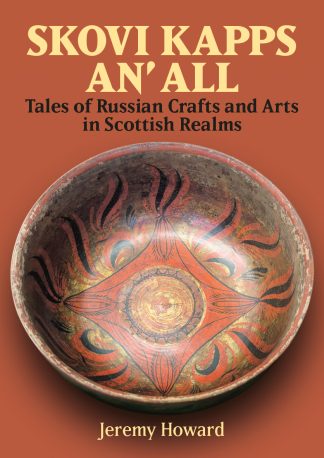
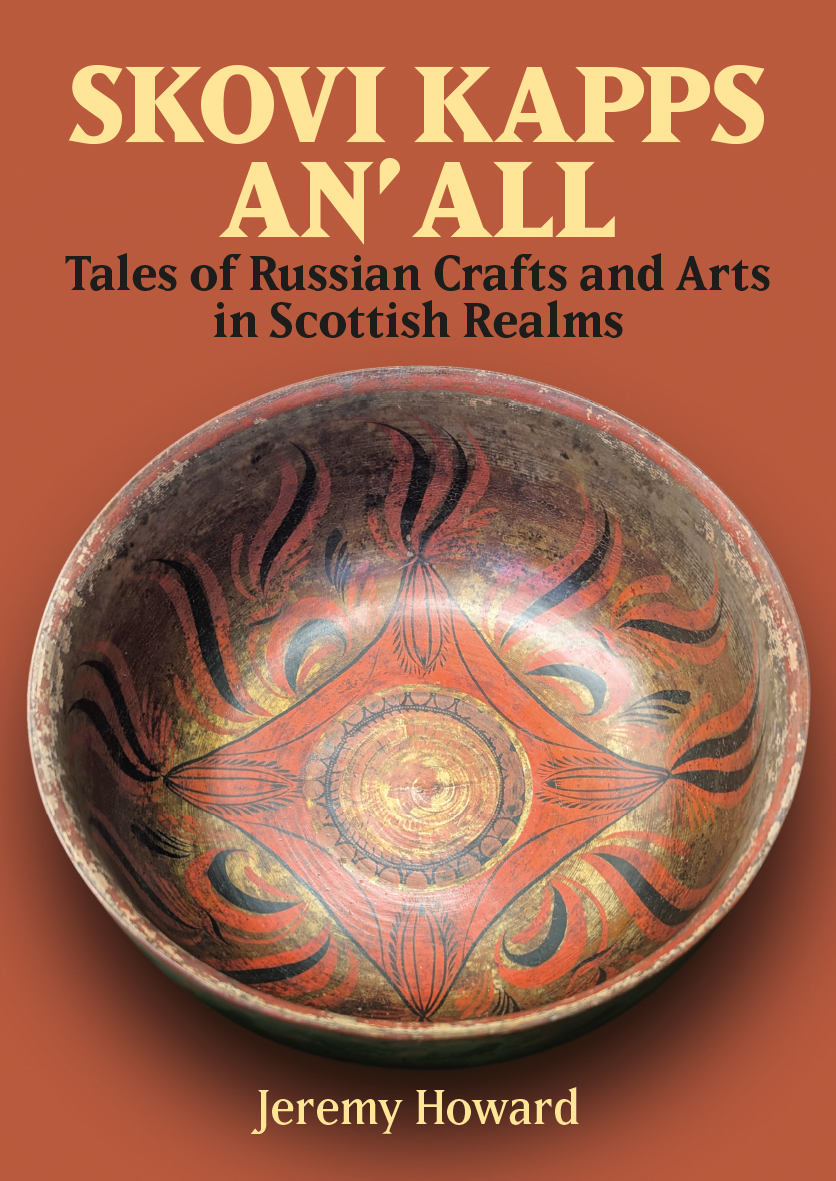
Skovi Kapps an’ All
Tales of Russian Crafts and Arts in Scottish Realms
Skovi kapps are distinctively painted wooden bowls from Russia. During Tsarist times huge quantities were brought to Scotland and other parts of the British Isles. This book relates the stories of their making, journey, reception and reinvention. It then contextualises these with accounts of a swathe of other forms of peoples’ art from Russia that made similar journeys during the same period. The first turn is to the remarkable collections of intricately carved wooden cutlery and painted distaffs acquired by the Edinburgh Museum of Science and Art (now National Museum of Scotland), the former telling of the life of St Sergius, the latter spinning yarns of Russian womanhood and country ways.
Against a backdrop of trade ties, empathy and conflict, the tales move to reveal types of ‘sputnik’ (‘travelling companion’) art that reached Scottish audiences, notably ‘acting’ bears, immersive dioramas and bronze Cossacks. They then challenge stereotypical ideas of ‘Russianness’ by uncovering the groundbreaking Scottish appreciation of the craft and culture of the Bashkirs, the nomadic Turkic and mainly Moslem nation of the steppe. Thus we encounter the perspicacious Bashkir representations of painter William Allan, geologist Roderick Murchison and George Carrick, doctor-proponent of kumis (fermented mare’s milk). The tales are rounded off by probing the vitalised displays of identity that comprised the Russian village at the 1901 Glasgow Exhibition and Madame Pogosky’s Russian Peasant Industries Depôt based in Edinburgh.
About the author
Jeremy Howard can be labelled an art, design and culture historian who has a particular interest in modern era connections between Europe (east, centre, north and south) and Scotland. His PhD was on experimental and cosmopolitan art in early-twentieth-century St Petersburg. While teaching at the University of St Andrews over the past thirty-five years he has also lectured and published widely. His books include Diapason: Essays on Latvian Artistic Outreach (Neputns, 2026), Balkan Fabrications: From Fra and Jessie Newbery’s ‘Serbian’ Turn (Sansom, 2022), St Petersburg (National Geographic, 2007), and East European Art (Oxford University Press, 2006), as well as the co-authored (with Irēna Bužinska and Z.S. Strother), Vladimir Markov and Russian Primitivism (Routledge, 2016).